
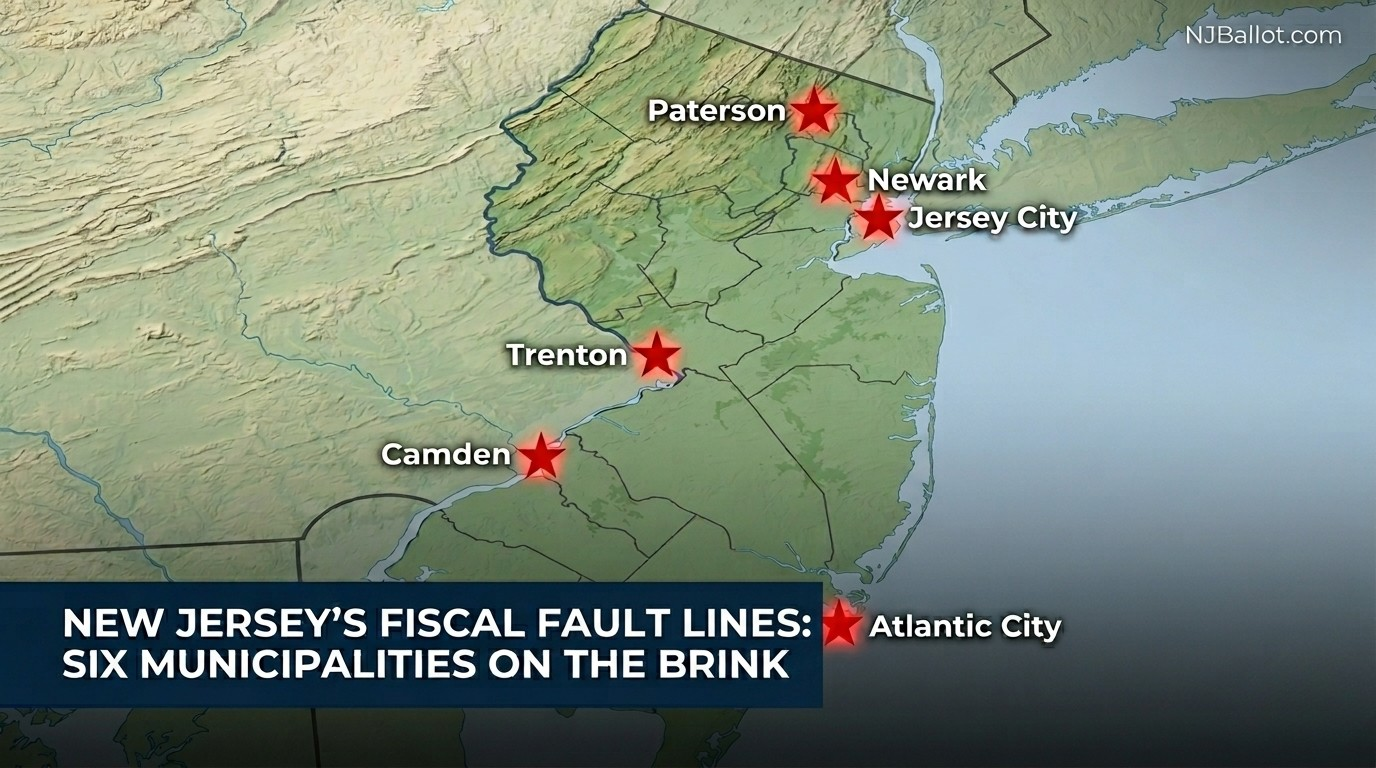

TRENTON—New Jersey's most financially fragile cities are not failing for the same reasons, nor is the state rescuing them with the same tools. Across Camden, Trenton, Paterson, Newark, Jersey City and Atlantic City, a fragmented system of municipal aid treats symptoms differently while the underlying disease of structural revenue collapse metastasizes.
The numbers tell divergent stories. Newark operates on a $970.6 million municipal budget with $52 million in transitional state aid, a 5.4% dependency ratio that looks manageable until you notice the $25-per-day penalty the city paid for 59 days of late budget adoption: $1,475 in fiscal year 2025 alone.
Atlantic City, still under state control, has cut taxes six consecutive years and built a $78 million surplus, but still carries $328 million in debt, down from $550 million pre-takeover. Camden spends roughly $85 million annually, more than a third of its municipal budget, on county police services through an interlocal agreement with the Camden County Police Department, a dependency that predates any state intervention.
The Capital's Structural Deficit
Then there is Trenton, where the diagnosis is different entirely. More than half the property in New Jersey's capital city is tax-exempt, not because of abatements or policy choices, but because the state government itself pays nothing in property taxes. The city has a 65.63% assessment ratio and a 5.80 tax rate per $100 of assessed value, among the highest in the state. Trenton receives $76,575 annually from its municipal Water Board as PILOT (Payment In Lieu of Taxes) revenue, but receives no PILOT payments from state government property, which occupies the majority of tax-exempt land. New Jersey's PILOT statute, N.J.S.A. 40A:20-1, applies to developers and redevelopment projects, not to state property occupancy. The result is a city that cannot tax its largest employer and relies on transitional aid to close gaps that widen annually.
Models of State Intervention
The state's response has been tactical, not strategic. In Paterson, the Attorney General's office is absorbing the entire cost of federal police oversight. That came to $10 million in fiscal year 2025, down from $12 million the previous year. $7.6 million of that total was already spent, including $4.5 million in police overtime and $950,000 in state salaries. This "supersession" model, where the state takes over a municipal police department under federal consent decree, effectively zeroes out direct municipal liability.
Jersey City presents the inverse problem: too much PILOT revenue, not too little. The city collected $103 million in payment-in-lieu-of-taxes revenue in 2023 while forgoing $256 million in traditional property taxes, with more than 100 properties operating under long-term abatements. The 95%-5% split (95% to the municipality, 5% to the county, 0% to the schools) has made abatements attractive to developers and fiscally addictive to City Hall. That's even as the state school funding formula claws back aid based on the city's "ability to pay." In January 2026, newly-inaugurated Mayor James Solomon issued an executive order auditing all 100-plus abatements for compliance, a signal that the era of unchecked PILOT expansion may be ending.
The Limits of Takeover
The abatement audit coincides with the arrival of a new state enforcer. Attorney General Jennifer Davenport, confirmed February 24, 2026, has inherited the Paterson supersession model and a portfolio of public corruption prosecutions her predecessor prioritized. What is clear is that the tools at her disposal address symptoms of fiscal stress without touching its root causes.
Atlantic City's recovery illustrates the limits of state intervention. The municipal takeover by the Local Finance Board in 2016 stabilized finances through emergency management. But it did not rebuild the tax base. The city remains dependent on the state and the Casino Reinvestment Development Authority, which in 2024 extended its funding authorization through 2038. The extension ensures that casino PILOT payments continue to comprise more than 70% of Atlantic City revenue. The CRDA model, like the Paterson supersession, substitutes state-controlled revenue streams for local tax capacity without restoring local fiscal autonomy.
Newark's distinction is longevity. The school district has been state-operated since 1995, the longest state takeover of a school district in the nation. The municipal government, meanwhile, runs a $970 million budget with conventional transitional aid. The separation is absolute: the $52 million aid from the Department of Community Affairs payment supports municipal operations, not schools. The result is a city with two governments, one state-controlled for three decades, the other state-aided but locally administered, neither with sufficient revenue independence.
Substitutions, Not Solutions
The common thread is substitution. Whether through Police Department aid in Camden, supersession in Paterson, PILOTs in Jersey City, transitional aid in Trenton and Newark, or the CRDA in Atlantic City, the state has replaced local revenue capacity with controlled funding streams that keep cities solvent but not self-sufficient. The models differ but the outcome converges: New Jersey's distressed cities survive at the state's pleasure, with fiscal autonomy eroded by decades of municipal mismanagement, structural exemption, abatement and takeover.
What remains unaddressed is the structural question that Trenton exemplifies: when the state itself is the largest landowner in the capital city, and the PILOT statute excludes state property by design, how does a city ever achieve fiscal independence? The answer, for now, is that it doesn't. Trenton, like its five counterparts, manages dependency rather than solving it: one budget cycle, one aid payment, one audit at a time.
Related Articles
• Atlantic City State Oversight Extended to 2031
• State Lawmaker Publicly Questions Newark BOE’s $1.4M Literacy Contract Amid Low Reading Scores
• The Handover: Paterson Schools After Five Years of Local Control
• Jersey City School Board Approves 17% Tax Levy Amid $74M Aid Loss
Sources
• Camden City Budget FY2024-2025, camdennj.gov
• Camden County Police Department (CCOPSA) Budget FY2024
• Chalkbeat NJ, "‘No evidence’ that NJ takeover of Camden schools improved students’ test scores, report says” (May 2021)
• Hudson County View, "Solomon signs exec. orders to audit all Jersey City tax breaks, lowering parade fees" (January 21, 2026)
• City of Newark, FY2025 Municipal Budget (December 2024)
• New Jersey Department of Community Affairs, Local Finance Notice 2025-12: Payment in Lieu of Taxes (March 2025)
• New Jersey Department of Community Affairs, Transitional Aid Reports FY2024-2025
• New Jersey Division of Local Government Services, Property Assessment Data
• New Jersey Legislature, S2 School Funding Formula,
• New Jersey State Budget FY2025, Paterson Police Supersession Funding
• WHYY, "Trenton mayor pushes state aid for revenue-starved city" (March 2019)
• NJ.com, "This city lost control of its police department. N.J. Supreme Court says that was legal" (July 23 2025)
• NJTOD.org, "Jersey City PILOT Payments Update" (March 2024)
• Press of Atlantic City, "Atlantic City mayor announces 3.4-cent tax rate cut as part of $258 million budget" (April 16, 2025)
• Press of Atlantic City, "Bills would give CRDA back some money for projects, extend developer benefits another 20 years" (October 2025)
• TAPinto Newark, "Newark Finally Adopts 2025 Budget with Slightly Reduced Tax Impact" (October 2025)
• Trenton City FY2025 Budget