
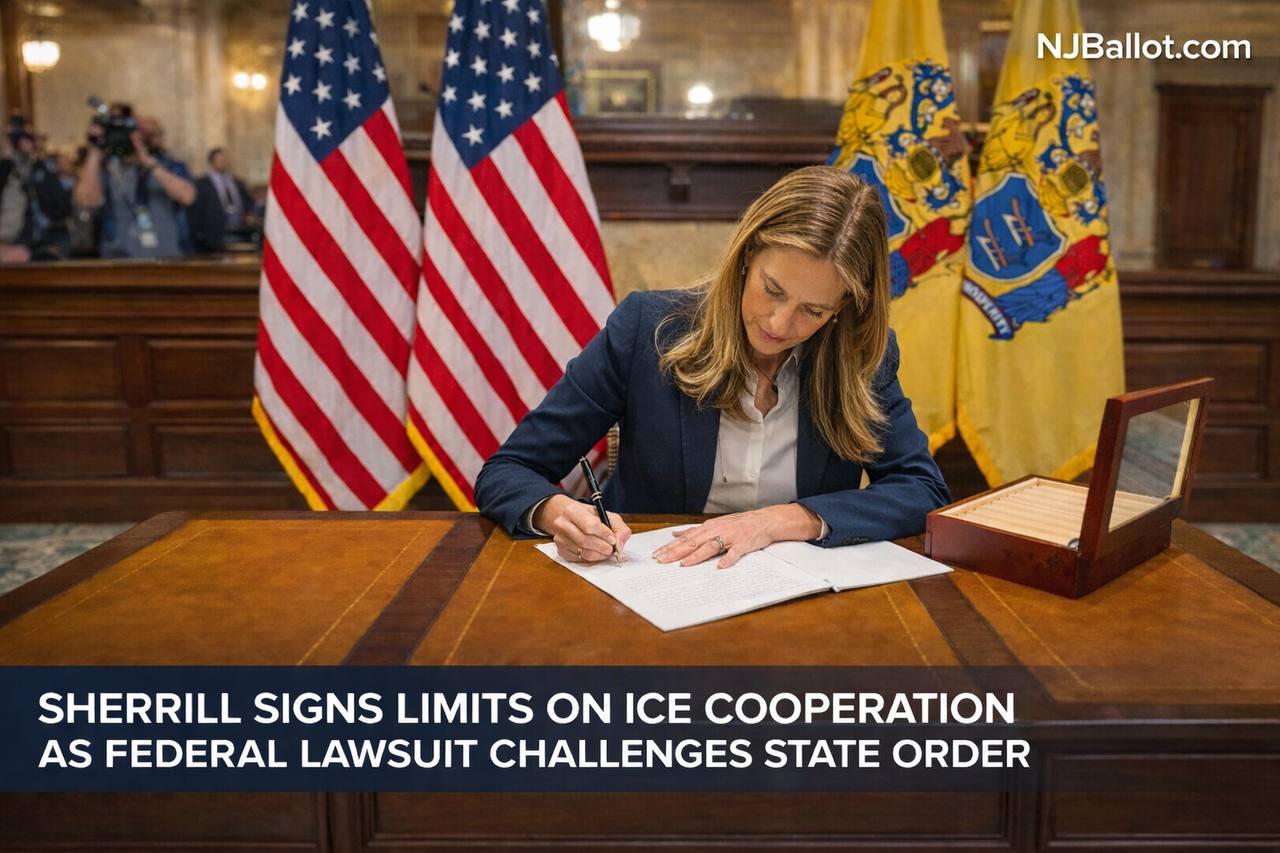

PRINCETON—Governor Mikie Sherrill signed a bill last month that limits how state and local cops can work with ICE. The signing came three months after her predecessor Phil Murphy vetoed the same idea on his way out the door. The ink was barely dry when federal lawyers started circling.
The Data-Sharing Loophole
The measure passed 22-13 in the Senate two days earlier, with Republicans arguing that it handcuffs law enforcement. It enshrines a 2018 Attorney General directive into statute while repealing the old 2007 rules. The bill says police can ignore ICE detainers except for violent felonies. But here's the catch: it keeps the part of federal law that mandates information-sharing about citizenship status. So cops can't hold people for ICE but they still have to tell ICE who they are. The bill as written is a compromise that satisfies nobody, leaving immigrants’ information open to law enforcement while drawing fire from the federal government.
Bramnick Breaks Ranks, Votes for Mask Ban
Atlantic County Senator Michael Testa (R) tried to challenge some of the bill’s provisions, offering an amendment that would have forced state and local police to notify federal agents when they arrested any migrant convicted of murder rape or human trafficking. It failed on party lines. Senator Jon Bramnick, who has positioned himself as a moderate, abstained from the final vote after backing a separate bill requiring officers to show their faces during enforcement actions.
Federal attorneys had already filed suit in Newark two weeks before the signing. Case 1:26-cv-2037 seeks to crush Sherrill's Executive Order 12, which she signed on February 11 and which bars ICE from state property without judicial warrants. The complaint cites 8 U.S.C. §§ 1226 and 1231, arguing the order violates the Supremacy Clause and obstructs mandatory detention statutes.
The filing makes an admission that drew blood from immigrant advocates. DOJ lawyer Robert Lindefjeld acknowledged that ICE agents have violated court orders in 52 separate instances since December. That's roughly one in ten cases involving protected individuals. New Jersey Attorney General Jennifer Davenport fired back that the Trump Administration is wasting resources on a pointless challenge instead of working with the state to promote public safety.
Federal strategy leans on a Third Circuit ruling from last July. In CoreCivic Inc. v. Governor of New Jersey, 145 F.4th 315, the court struck down the state's prior ban on private detention contracts under Supremacy Clause grounds. That decision held that New Jersey's attempt to prohibit facilities like Elizabeth Contract Detention and Delaney Hall in Newark "wholesale deprives the federal government of its chosen method of detaining individuals."
Assemblywoman Dawn Fantasia (R) cited that precedent during floor debate warning that every single time a state tries this it gets struck down in court. Both facilities keep running anyway.
Elizabeth holds about 300 detainees under CoreCivic. Delaney Hall houses 1000 under a $1 billion GEO Group contract signed February 2025. Federal money, not state dollars, pays for both facilities, which limits the practical impact of separate proposed legislation to block public funding for detention construction. That measure would affect only future construction, since existing facilities run on federal contracts that the state cannot touch under current precedent.
Municipal Governments Led Anti-ICE Restrictions
Municipal governments had already started building their own walls before Trenton acted. Jersey City Mayor James Solomon signed an order January 31 prohibiting the use of city property as ICE staging areas. Kearny passed a resolution February 10 barring federal agents from municipal facilities. These local moves preceded the state signing by nearly two months, showing how layered jurisdictions responded when enforcement operations spiked after January 20.
In a parallel action, the Attorney General's office and Roxbury Township jointly sued the Department of Homeland Security on March 20. The suit aims to block ICE's conversion of a 470,000-square-foot warehouse into a 1500-bed detention facility. ICE purchased the Roxbury property for $130 million in February, prompting immediate municipal opposition that now has state backing.
The numbers tell a story about who's actually affected. Between January 20 and February 17, ICE issued 437 detainers to New Jersey law enforcement agencies. Only 109 resulted in ICE taking custody. That's a 25 percent compliance rate. Seventy-two percent of detainer targets had no criminal convictions beyond immigration violations. The most frequent charges were traffic offenses and driving under the influence.
ICE Actions Disrupt Medical Care and Education, Say Doctors, Teachers
Medical professionals say the enforcement climate is disrupting health care delivery. A survey by Physicians for Human Rights found that 84 percent of clinicians in high-immigrant areas watched patient visits drop since the 2025 crackdown began. Seventy-eight percent of likely undocumented adults now fear that medical information gets shared with immigration authorities. New Jersey's twenty-three federally qualified health centers served 624,678 patients in 2024. Now they face reimbursement cuts under recent HHS guidance that limits funding for care provided to undocumented patients.
School administrators report similar fears. The Department of Education issued guidance last August reminding districts that Plyler v. Doe prohibits enrollment discrimination based on immigration status. State regulations bar requiring social security cards or tax returns for student registration. But regulatory protections haven't calmed parents’ nerves about data sharing in immigrant-heavy districts.
With the DOJ lawsuit pending and the Third Circuit precedent looming, the framework established on Friday faces immediate legal pressure. Judges must determine whether the $1 million annual implementation cost represents a sustainable investment in state autonomy or preparation for a preemption challenge that could invalidate the statute before it takes full effect. Whether that balance satisfies the court will determine the outcome.
Sources
• New Jersey Office of the Governor, “Governor Sherrill Signs Legislation to Protect Constitutional Rights, Keep New Jerseyans Safe” (March 25, 2026)
• New Jersey Office of Legislative Services, NJ S3521 (2026). LegiScan NJ, 2026-2027 Session. NJ S3864 bill text regarding prohibition on public funding for immigrant detention facilities.
• InsiderNJ, “Statement from Acting Attorney General Jennifer Davenport on DOJ’s Lawsuit Challenging Governor Sherrill’s Executive Order 12” (February 24, 2026)
• New Jersey Office of the Attorney General, “Governor Sherrill, Attorney General Davenport, Roxbury Township Sue ICE, DHS Over Plans to Convert Warehouse into Mass Detention Facility” (March 20, 2026)
• U.S. Department of Justice, “Justice Department Files Lawsuit Against New Jersey for Interfering with Federal Immigration Laws” (February 24, 2026)
• U.S. Court of Appeals for the Third Circuit, CoreCivic Inc. v. Governor of New Jersey, 145 F.4th 315 (July 22, 2025)
• Politico New Jersey, “New Jersey moves to limit state role in federal immigration enforcement” (March 25, 2026)
• Michael Testa, “ICYMI: Democrats Block Testa Amendment Requiring Feds be Notified When Rapists, Murderers Released” (March 25. 2026)
• NJ Spotlight News, “ICE plans contract extension for Elizabeth detention center” (March 26, 2026).
• NJBallot.com, “Sherrill Signs ICE Mask Ban, Sanctuary Bills Into Law” (March 25, 2026)
• Physicians for Human Rights, “ICE Tactics and Deportation Fears Limit Access to Health Care for Children of Immigrants” (November 19, 2025)
• New Jersey Department of Education, “Enrollment of Students Based Upon Immigration Status” (August 13, 2025)
• City of Jersey City, “Mayor Solomon Signs Expansive Executive Order Protecting Jersey City's Immigrants” (January 23, 2026)
• Hudson County View, “Kearny council bans ICE from town property, calls for Gateway funding restoration” (February 12, 2026)
• Brennan Center for Justice, “How ICE’s Budget Boom Is Changing Immigration Detention” (February 24, 2026)